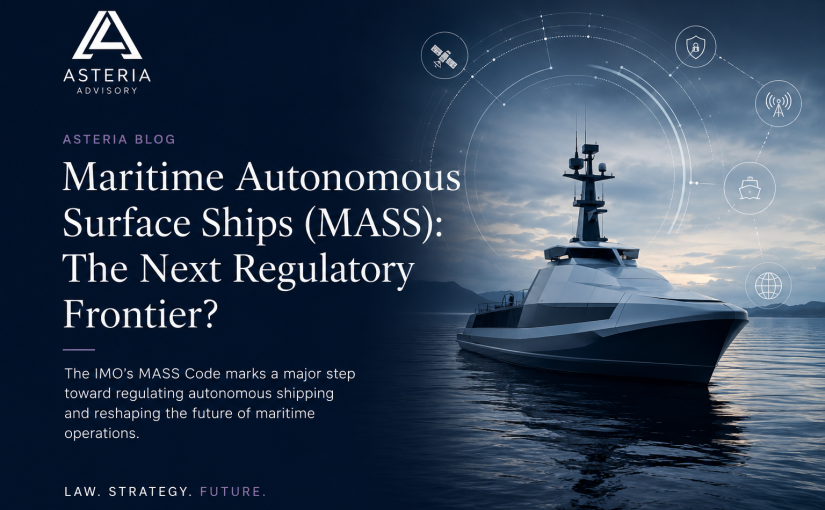
Autonomous shipping is no longer a distant concept confined to prototypes and technology expos. It is rapidly becoming an operational and regulatory reality. The International Maritime Organization (IMO) has now taken a significant step forward with the development of the International Code of Safety for Maritime Autonomous Surface Ships (MASS Code), marking a major milestone in the governance of autonomous maritime operations.
As technology accelerates, the maritime sector finds itself at a familiar crossroads: innovation moving faster than regulation.
What Are Maritime Autonomous Surface Ships?
The IMO defines Maritime Autonomous Surface Ships (MASS) as vessels capable of operating with varying degrees of autonomy, ranging from automated onboard systems to fully autonomous ships operating without human intervention.
Importantly, autonomy is not binary.
The IMO has identified different levels of autonomy, including:
- ships with automated decision-support systems;
- remotely controlled vessels with crew onboard;
- remotely controlled vessels without crew onboard; and
- fully autonomous ships capable of making operational decisions independently.
This layered approach reflects the reality that maritime autonomy will likely evolve gradually rather than through an immediate transition to entirely crewless vessels.
The Regulatory Challenge
The development of MASS raises fundamental legal and operational questions.
Many existing international maritime conventions were drafted on the assumption that a vessel would always have:
- a master onboard;
- a physical crew;
- and direct human decision-making at sea.
Autonomous shipping challenges those assumptions directly.
The IMO’s regulatory scoping exercise, completed in stages between 2021 and 2022, examined how existing treaties — including SOLAS, COLREGs, STCW, and liability frameworks — might apply to autonomous operations.
Questions identified include:
- who constitutes the “master” of an autonomous vessel;
- how watchkeeping obligations are fulfilled remotely;
- liability allocation following incidents;
- cybersecurity risks;
- and how safety obligations apply where human intervention is limited or absent.
These are not merely technical issues. They go to the heart of maritime law’s structure.
The MASS Code
In May 2026, the IMO adopted the first non-mandatory MASS Code — a goal-based framework intended to guide the safe operation of autonomous ships.
The current roadmap anticipates:
- a non-mandatory implementation phase;
- an experience-building period;
- and eventually the development of a mandatory MASS Code linked to SOLAS amendments.
This gradual approach reflects the complexity of balancing:
- innovation;
- commercial realities;
- safety obligations;
- cybersecurity concerns;
- and the human element of shipping.
Cybersecurity and Operational Risk
One of the most significant concerns surrounding autonomous shipping is cybersecurity.
As vessels become increasingly dependent on:
- remote connectivity;
- AI-assisted navigation;
- automated systems;
- and data-driven decision-making,
they also become more vulnerable to digital threats.
Cybersecurity is therefore no longer simply an IT concern — it is becoming a core safety and operational issue for the maritime industry.
The Human Element Remains Central
Despite growing automation, the IMO has consistently emphasised that the human element remains central to maritime safety.
Even highly automated operations will require:
- remote operators;
- technical oversight;
- emergency intervention capabilities;
- and updated training frameworks.
This raises important future questions for:
- STCW compliance;
- certification;
- remote operation centres;
- and the evolving role of seafarers ashore and at sea.
Beyond Technology: A Structural Shift
Autonomous shipping is not simply about removing crews or introducing advanced navigation systems.
It represents a broader transformation in how shipping may operate:
- commercially;
- legally;
- operationally;
- and environmentally.
“The implications extend beyond vessels themselves to ports, insurers, classification societies, flag states, financiers, and maritime legal frameworks, including evolving considerations surrounding ship registration and flag state oversight.
As with previous technological transitions in shipping, regulation will play a decisive role in determining how quickly — and how safely — these technologies are integrated into global trade.
Looking Ahead
The development of Maritime Autonomous Surface Ships marks one of the most significant regulatory evolutions currently facing the maritime sector.
The challenge is no longer whether autonomous operations will emerge.
It is whether international legal frameworks can evolve quickly enough to govern them effectively. Many of the governance questions emerging in autonomous shipping — from AI-assisted operations to remote decision-making — also resonate increasingly within wider discussions surrounding space law and autonomous systems
At Asteria Advisory, developments in maritime regulation, transport innovation, and emerging operational frameworks remain central to how we approach our maritime advisory services and monitor the future of the industry.
